Follow this blog with bloglovin

Follow kimcrawley.com- Bright Ideas
Showing posts with label web. Show all posts

Thursday, November 25, 2010

A Brief History of the Web- Part nine...


  Finally, my 'Brief History of the Web' series continues with part nine.  I'm sorry for the long delay.  I've been busy writing for Blogcritics and Dragon Blogger.  I also was busy creating a website for my father and stepmother, Telltale.ca.  More about that in my next post...

  If you've missed previous posts in my 'Brief History of the Web' series, here's your opportunity to catch up.


   In part eight, I told the tale of Mozilla Firefox, which debuted in 2004, and the other web browsers in the new browser war, Google Chrome, Opera, and Safari.  The days of IE versus Netscape are no more, but much of Netscape Navigator's code lives on in Firefox.

   Earlier in the series, I introduced Friendster, which was the launch of social networking as we know it today.

  Friendster launched in 2002, and became a web phenomenon by 2003.  Well, employees of eUniverse, which later became Intermix Media, took notice.  Intermix founder Brad Greenspan, Chris DeWolfe, Josh Berman and Tom Anderson launched Myspace in August 2003, months before Firefox made its public debut.

   Actually, Chris DeWolfe already owned the Myspace.com domain as a website for customer data storage and web hosting.

Myspace.com in 1997
   

Myspace.com in 2000


  In February 2004, Richard Rosenblatt became Myspace's CEO, and Myspace went from a little unknown website, to a Friendster killer.  

Myspace.com in October 2003
  
Myspace.com in October 2004, after Richard Rosenblatt took the helm


     Throughout 2004 and 2005, fewer and fewer people were using Friendster, and more and more people started using Myspace.  It was a boon for musicians, because they can feature their music in their profiles.  Myspace started to generate a huge amount of ad revenue for Intermix, until Intermix and Myspace were bought by News Corp. for $580 million in July 2005.


Myspace.com in October 2009
  By 2008, though, Facebook started to make gains ahead of Myspace in the number of users.  Now, Facebook is the Goliath to Myspace's David.  In 2010, Myspace debuted a remarketing campaign.  Myspace is now officially stylized as my______, and the site has a new look, with new features.


Myspace.com today, with a new look

      Time will soon tell how successful Myspace's rebranding campaign will be.  Richard Rosenblatt left the company in 2006, and founded Demand Media, the company behind eHow.com.  In my very brief career there as a writer, I learned how horrible Demand Media is to their writers.  See the views of other former Demand Media writers- Demand Studios, 4 Reasons Why It Sucks on Hubpages.com.


     It's a little known fact that YouTube launched as a Myspace widget.


    The YouTube website launched on Valentine's Day 2005, after YouTube's success on Myspace.


YouTube in April 2005


  Former Paypal employees Chad Hurley, Steve Chen and Jawed Karim founded YouTube.  They saw a need for an easy video sharing venue on the web.  The very first YouTube video was uploaded by Jawed Karim on April 23rd, 2005, titled Me at the zoo.  Here it is!


    The YouTube beta test started in May 2005, and the official launch was in November.


    By November 2006, Google bought YouTube for $1.65 billion.  Yes, that's a BILLION, not a million.


    As of November 2010, videos have been viewed via YouTube over 14 billion times.


    When 'A Brief History of the Web' continues very soon with part ten, learn how Facebook started!  Well, we all saw The Social Network, so it'll be a brief refresher course.


kimcrawley.com


twitter.com/kim_crawley


blogcritics.org/writers/kim-crawley/

Wednesday, November 10, 2010

A Brief History of the Web- Part eight...


   Here it is, the much awaited part eight of my 'A Brief History of the Web' series.   I've been super busy, between the lab, Blogcritics and Dragon Blogger, but I apologize for the delay.


   Here's your opportunity to catch up with the series, my most popular to date:


       In this part, we return to the browser wars.


       In the 1990s, the fight was between Netscape Navigator and Microsoft Internet Explorer.  Netscape's browser debuted in 1994, and IE debuted in 1995.  People used to design web pages better for the standards of one browser or another.   Many web designers thought, if you're using Netscape, for instance, and their site says 'Best Viewed In Internet Explorer', you would of course click on the download link, and install IE just to view their website!  Of course, their website was so awesome that you'd be compelled to do just that.  Well... no, not really.


    Ha, I think this is the only time I'll ever use an animated GIF in this blog...


        As the year 2000 passed, Netscape quickly lost market share.   But, that wasn't the end for Netscape's Mozilla user agent string!


        Mozilla was originally a codename for Netscape Navigator.  As of 1994, the main web browser was Mosaic (see parts one and two) and Mozilla meant 'Mosaic Killer'.


      The Mozilla Organization was founded in 1998, by Netscape programmers, to create a successor to Netscape Navigator.   By 2003, it became a funded non-profit organization renamed the Mozilla Foundation.


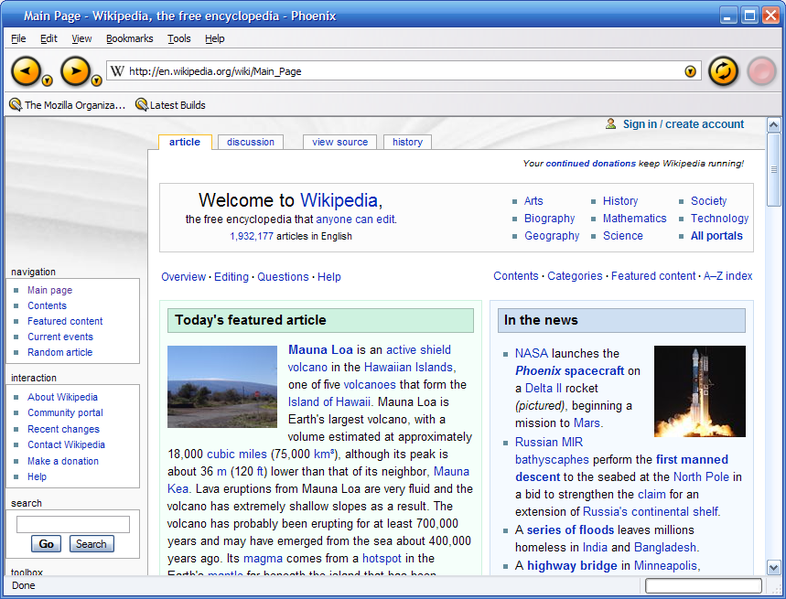
       In 1998, the source code behind the Netscape Communicator suite was released open source under the new Netscape Public License.  The first web browser to come out of the new Mozilla project was Phoenix 0.1,  released in September 2002, but only as a binary for testing.


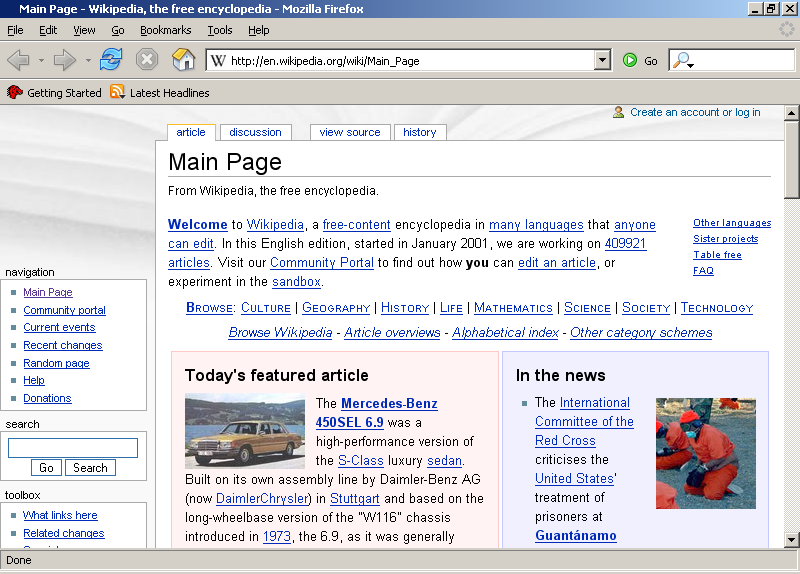
    This image, and the other browser shots here are courtesy of Wikipedia


       The first publicly available version was Firefox 1.0, in late 2004.  They couldn't use the Phoenix name,    a company named Phoenix Technologies weren't very happy.  So then, Mozilla tried the name Firebird, but the Firebird Database Server wasn't happy with that either.   Firefox was the next option, and the one that stuck.


       Here's what that very first public version, Mozilla Firefox 1.0 looked like:


        As Firefox 2 and 3 were released, the browser quickly gained market share, taking a major bite out of IE.   The browser wars were changed, forever.


      Firefox was the browser to introduce tabbed browsing, something I would've loved to have as a teenager in the 1990s.   I used to run multiple browsers, so that I could enjoy a web page while waiting for another to DOWNLOAD.   It was kind of taxing for a system using 128 MB RAM.   Ah, those were the days.


       Opera, which didn't gain major market share, but has a significant sliver of the pie (about 4%), was actually introduced in December 1996 by Norway's Opera Software.   They are now up to an initial alpha release of 11.


       Aside from Opera's relatively lean code, what also sets Opera apart is their focus on accessibility.  Options include having key commands for all actions, mouse gesturing, and voice control.  


       Apple entered the browser wars a lot later than Microsoft did.  Their Safari browser publicly debuted in January 2003, and became the default web browser for Mac OS X 10.3 'Panther'.   Before Safari, the web browser most frequently used on Macs was the Mac version of IE.  Microsoft no longer supports a Mac version of their browser, so IE now only runs in Windows OSes.


       Safari is now up to 5.0.2.  It's a pretty good browser, it works really well with HTML5 and CSS3.   They started a Windows version in 2007.  The main reason why I wouldn't recommend Safari is because it's Crapple!  (See Why I'll never spend a dime on Apple products...)   There's no version of Safari for GNU/Linux OSes like the one I'm using, as Apple likes to pretend that Linux distros don't exist.  I could run Safari for Windows in Wine, but why would I want to?


       My 'A Brief History of the Web' will continue soon.  Until then, I have lots more in store for you!


    kimcrawley.com


    twitter.com/kim_crawley


    blogcritics.org/writers/kim-crawley/

    Friday, October 22, 2010

    A Brief History of the Web- Part five...


       Welcome back to my popular 'A Brief History of the Web' series, much spoken about on TwitterBlogEngage.com, and Bloggers.com.  I feel like I have some fans now who look forward to new articles in this series, and I don't want to let you guys down!

      Here's a re-cap, in case you've missed one of the articles:


      As I left off in part four, more and more ordinary people started surfing the web.  The new, popular search engines made that feasible.

      Netscape launched their Navigator web browser, based on Mozilla framework, in 1994.  Microsoft saw a market they had to enter, so they launched Internet Explorer in 1995, along with MSN, to originally compete with AOL, which was once mighty.

      And GeoCities, Tripod and Angelfire launched, making it easier for web surfers who weren't technically proficient to publish their own content.

      Social networking is also a phenomena that has caused significant growth of the web.  Most people think social networking on the web started in the 2000s with MySpace and the like.

      Actually, AOL, GeoCities, and Tripod all had some social networking functionality.  Users could meet other users through their chat services and their personal pages.

      But the very first 'proper' social networking website wasn't MySpace of Friendster.  It was now defunct theGlobe.com.  That also very nicely leads into the 'dot com bust' theme of this article.  It was actually launched in 1995!

      It became very popular in the late 1990s, especially in 1998, when they launched their IPO, becoming publically traded.

    A screenshot of theGlobe.com from 1998, the oldest I could find from archive.org.

      Two Cornell students, Stephan Paternot and Todd Krizelman, started theGlobe.com when they got a brilliant idea.  They found the early chatrooms on Cornell's network were very popular.  They saw a moneymaking opportunity.  They raised $15,000 over Christmas 1994 to buy their first web server and launch their company.


      Their website went live on April 1st, 1995, and quickly became very popular.  But any money they made didn't go into equity, it went to more and more growth.  More employees, more web servers, and more of everything else.


      They had to go public to raise more funds.  Their IPO launched on November 13th, 1998.


       Their target share price was $9.00.  But, investors thought they saw the new AOL!  (Well, they kind of did, in sense.  AOL lost AOL Time Warner massive amounts of money in the early 2000s.  But in 1998, AOL could do no wrong, and investors thought any 'dot com' launch was a huge moneymaking opportunity.)


      During theGlobe.com's first trading day, their share price rose as high as $97.00, more than ten times the target share price.  Astonishing!


      Paternot and Krizelman's new corporation bought a number of other properties, in their bouts of spending enthusiasm.  They bought Chips and Bits, Computer Games magazine, and happypuppy.com.  You never heard of those names?  That explains everything!


      From The Guardian in 2001:


    Theglobe.com founder Stephan Paternot, has written a book called A Very Public Offering. In it he recalls a CNN interview from 1999 which captured him dancing on a nightclub table in shiny black pants with his model girlfriend, Jennifer Medley and saying, "Got the girl. Got the money. Now I'm ready to live a disgusting, frivolous life."
    Nowadays Paternot is more circumspect. "I became the whipping boy of Silicon Alley, a symbol of the internet's success, excess and then the bursting of the internet bubble."


      Between 1999 (when most experts believe the 'dot com bust' began) and 2001,  theGlobe.com's shares went from a high of $97.00 to a low of 10 cents.  Ten cents!


      Paternot and Krizelman were forced out of the company they founded, in 2000.  TheGlobe.com shut down in August 2001.  In 2003, TheGlobe launched GloPhone, to compete with Skype.  That was another commerical failure.


      As of March 2010, the company reported that they had a mere $7,618 in assets toward their $3.1 million worth of liabilities.  Sounds like every entrepreneur's worst nightmare, as far as I'm concerned.


      Friendster's beta launched in 2002.


    Friendster beta page from May, 2002


    Friendster beta page from May, 2003

    Friendster launch page from December, 2004


       Friendster was the very first of the new style of social networking websites, predating MySpace, Bebo, Linked-In, Facebook and Twitter.


      Friendster is still online, as of this writing.  As of June 2010, they have about 8,200,000 users.  Friendster was founded by two computer programmers, Jonathan Abrams and Cris Emmanuel.  It kind of functions like Facebook, but with a lot fewer extras.


       Compared to Facebook's current over 500 million users, and Twitter's current 30 million users, Friendster is now a minor player in the social networking scene.


       But, Friendster's model of user pages and linking to friends set a paradigm for most social networking sites that launched later on.


      Case in point- in August 2010, Facebook confirmed that it acquired 18 patents from Friendster.


      In part six of my 'A Brief History of the Web' series, I will go further into the 'dot com bust' of 1999-2001, mentioning the AOL Time Warner debacle, Pets.com and others.  I will also go into the social networking sites that launched after Friendster, and 'Web 2.0'.  Also, Netscape falls, and Internet Explorer gets a little competition in the browser market!


      In the meanwhile, I forgot to mention a pre-bust venture that was founded in 1994 and launched online in 1995.  It has been a huge commercial success since then, and up to this day.


      You must have heard of Jeff Bezos and Amazon.com, haven't you?  Amazon started exclusively as a bookseller, but now Amazon retails in as many different areas as a department store.


      Here's what Amazon's home page looked like in 1995:


       And here's what Amazon's home page looks like today:


      Stay tuned for part six, coming up on Monday!  In the meanwhile, over the weekend, there will be a couple of new posts here.


    kimcrawley.com


    twitter.com/kim_crawley


    blogcritics.org/writers/kim-crawley/