Follow this blog with bloglovin

Follow kimcrawley.com- Bright Ideas
Showing posts with label technology. Show all posts

Thursday, November 25, 2010

A Brief History of the Web- Part nine...


  Finally, my 'Brief History of the Web' series continues with part nine.  I'm sorry for the long delay.  I've been busy writing for Blogcritics and Dragon Blogger.  I also was busy creating a website for my father and stepmother, Telltale.ca.  More about that in my next post...

  If you've missed previous posts in my 'Brief History of the Web' series, here's your opportunity to catch up.


   In part eight, I told the tale of Mozilla Firefox, which debuted in 2004, and the other web browsers in the new browser war, Google Chrome, Opera, and Safari.  The days of IE versus Netscape are no more, but much of Netscape Navigator's code lives on in Firefox.

   Earlier in the series, I introduced Friendster, which was the launch of social networking as we know it today.

  Friendster launched in 2002, and became a web phenomenon by 2003.  Well, employees of eUniverse, which later became Intermix Media, took notice.  Intermix founder Brad Greenspan, Chris DeWolfe, Josh Berman and Tom Anderson launched Myspace in August 2003, months before Firefox made its public debut.

   Actually, Chris DeWolfe already owned the Myspace.com domain as a website for customer data storage and web hosting.

Myspace.com in 1997
   

Myspace.com in 2000


  In February 2004, Richard Rosenblatt became Myspace's CEO, and Myspace went from a little unknown website, to a Friendster killer.  

Myspace.com in October 2003
  
Myspace.com in October 2004, after Richard Rosenblatt took the helm


     Throughout 2004 and 2005, fewer and fewer people were using Friendster, and more and more people started using Myspace.  It was a boon for musicians, because they can feature their music in their profiles.  Myspace started to generate a huge amount of ad revenue for Intermix, until Intermix and Myspace were bought by News Corp. for $580 million in July 2005.


Myspace.com in October 2009
  By 2008, though, Facebook started to make gains ahead of Myspace in the number of users.  Now, Facebook is the Goliath to Myspace's David.  In 2010, Myspace debuted a remarketing campaign.  Myspace is now officially stylized as my______, and the site has a new look, with new features.


Myspace.com today, with a new look

      Time will soon tell how successful Myspace's rebranding campaign will be.  Richard Rosenblatt left the company in 2006, and founded Demand Media, the company behind eHow.com.  In my very brief career there as a writer, I learned how horrible Demand Media is to their writers.  See the views of other former Demand Media writers- Demand Studios, 4 Reasons Why It Sucks on Hubpages.com.


     It's a little known fact that YouTube launched as a Myspace widget.


    The YouTube website launched on Valentine's Day 2005, after YouTube's success on Myspace.


YouTube in April 2005


  Former Paypal employees Chad Hurley, Steve Chen and Jawed Karim founded YouTube.  They saw a need for an easy video sharing venue on the web.  The very first YouTube video was uploaded by Jawed Karim on April 23rd, 2005, titled Me at the zoo.  Here it is!


    The YouTube beta test started in May 2005, and the official launch was in November.


    By November 2006, Google bought YouTube for $1.65 billion.  Yes, that's a BILLION, not a million.


    As of November 2010, videos have been viewed via YouTube over 14 billion times.


    When 'A Brief History of the Web' continues very soon with part ten, learn how Facebook started!  Well, we all saw The Social Network, so it'll be a brief refresher course.


kimcrawley.com


twitter.com/kim_crawley


blogcritics.org/writers/kim-crawley/

Wednesday, November 10, 2010

A Brief History of the Web- Part eight...


   Here it is, the much awaited part eight of my 'A Brief History of the Web' series.   I've been super busy, between the lab, Blogcritics and Dragon Blogger, but I apologize for the delay.


   Here's your opportunity to catch up with the series, my most popular to date:


       In this part, we return to the browser wars.


       In the 1990s, the fight was between Netscape Navigator and Microsoft Internet Explorer.  Netscape's browser debuted in 1994, and IE debuted in 1995.  People used to design web pages better for the standards of one browser or another.   Many web designers thought, if you're using Netscape, for instance, and their site says 'Best Viewed In Internet Explorer', you would of course click on the download link, and install IE just to view their website!  Of course, their website was so awesome that you'd be compelled to do just that.  Well... no, not really.


    Ha, I think this is the only time I'll ever use an animated GIF in this blog...


        As the year 2000 passed, Netscape quickly lost market share.   But, that wasn't the end for Netscape's Mozilla user agent string!


        Mozilla was originally a codename for Netscape Navigator.  As of 1994, the main web browser was Mosaic (see parts one and two) and Mozilla meant 'Mosaic Killer'.


      The Mozilla Organization was founded in 1998, by Netscape programmers, to create a successor to Netscape Navigator.   By 2003, it became a funded non-profit organization renamed the Mozilla Foundation.


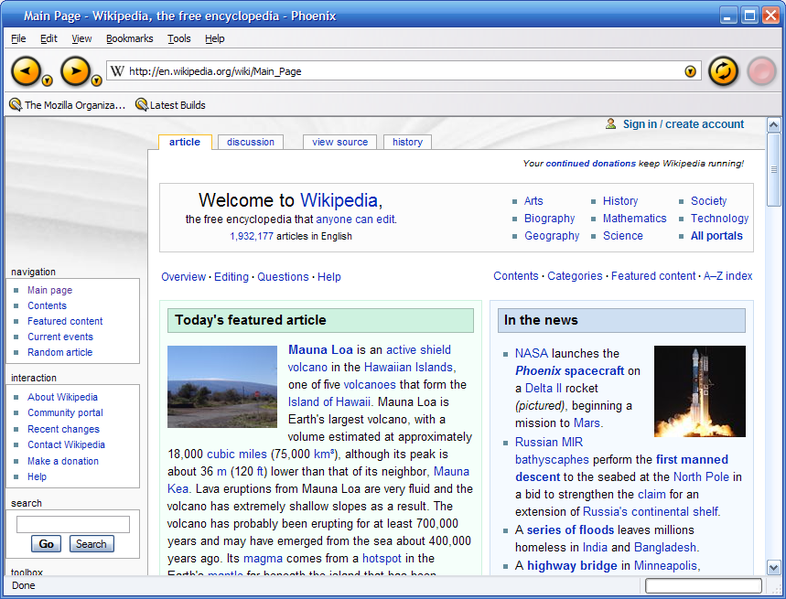
       In 1998, the source code behind the Netscape Communicator suite was released open source under the new Netscape Public License.  The first web browser to come out of the new Mozilla project was Phoenix 0.1,  released in September 2002, but only as a binary for testing.


    This image, and the other browser shots here are courtesy of Wikipedia


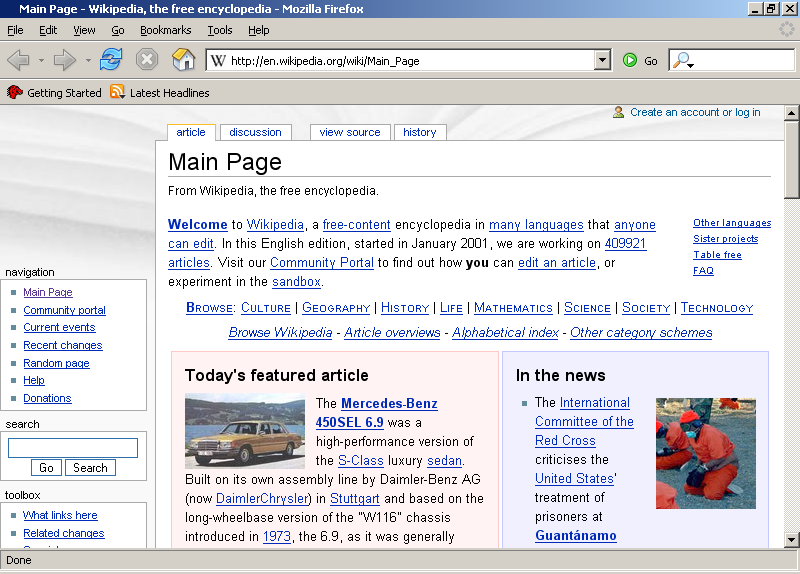
       The first publicly available version was Firefox 1.0, in late 2004.  They couldn't use the Phoenix name,    a company named Phoenix Technologies weren't very happy.  So then, Mozilla tried the name Firebird, but the Firebird Database Server wasn't happy with that either.   Firefox was the next option, and the one that stuck.


       Here's what that very first public version, Mozilla Firefox 1.0 looked like:


        As Firefox 2 and 3 were released, the browser quickly gained market share, taking a major bite out of IE.   The browser wars were changed, forever.


      Firefox was the browser to introduce tabbed browsing, something I would've loved to have as a teenager in the 1990s.   I used to run multiple browsers, so that I could enjoy a web page while waiting for another to DOWNLOAD.   It was kind of taxing for a system using 128 MB RAM.   Ah, those were the days.


       Opera, which didn't gain major market share, but has a significant sliver of the pie (about 4%), was actually introduced in December 1996 by Norway's Opera Software.   They are now up to an initial alpha release of 11.


       Aside from Opera's relatively lean code, what also sets Opera apart is their focus on accessibility.  Options include having key commands for all actions, mouse gesturing, and voice control.  


       Apple entered the browser wars a lot later than Microsoft did.  Their Safari browser publicly debuted in January 2003, and became the default web browser for Mac OS X 10.3 'Panther'.   Before Safari, the web browser most frequently used on Macs was the Mac version of IE.  Microsoft no longer supports a Mac version of their browser, so IE now only runs in Windows OSes.


       Safari is now up to 5.0.2.  It's a pretty good browser, it works really well with HTML5 and CSS3.   They started a Windows version in 2007.  The main reason why I wouldn't recommend Safari is because it's Crapple!  (See Why I'll never spend a dime on Apple products...)   There's no version of Safari for GNU/Linux OSes like the one I'm using, as Apple likes to pretend that Linux distros don't exist.  I could run Safari for Windows in Wine, but why would I want to?


       My 'A Brief History of the Web' will continue soon.  Until then, I have lots more in store for you!


    kimcrawley.com


    twitter.com/kim_crawley


    blogcritics.org/writers/kim-crawley/

    Sunday, October 31, 2010

    A Brief History of the Web- Part seven...


      To my dear readers, I apologize for the delay of part seven.  The one downside of my recent popularity on the blogging scene, and having to write articles for a number of major commercial websites, now including eHow.com, is that my time is a more precious commodity.

      I will not give up on this blog, and the maximum time between posts here should be about two days.

      My 'A Brief History of the Web' series is among my most popular work, and I aim to please!

       Make sure you read any parts you may have missed, first:


      So, there have been some major successes on the web, and the one I'm focusing on in this post is still a huge player, if not the HUGEST player, today.

       Google was founded by Larry Page and Sergey Brin.  They were PhD students at Stanford University.  They first met in 1995.   The following year, they created a search engine called BackRub, for the use of Stanford students and faculty.


    1996 BackRub screenshot, courtesy of blogoscoped.com

       BackRub- at old URL http://backrub.stanford.edu, don't try it now, you'll get a 404, became very popular on Stanford's campus.  It soon grew to a point that Stanford decided their bandwidth couldn't handle it anymore.

       Now, if Stanford were clairvoyant, they would have invested money into giving BackRub more bandwidth somewhere else, but they didn't.  Obviously, that was but a minor hurdle for Page and Brin.

    The very first screenshot of Google, from 1997.  This page was still hosted at backrub.stanford.edu.
         So, they started Google, in 1997, technically speaking.  'Google' is a play on the word googol, which in mathematical terms, means 1 plus 100 zeros, a number I won't bother to type out here.  The name was intended to represent the nearly infinite number of web pages that can be found by Google.

    From 1998, finally using the google.com domain.  This is the very first appearance of Google's colourful logo.  Soon afterward, the font was changed slightly, and the exclamation mark was dropped.  No more pretending to be like Yahoo!
      
      Sun co-founder Andy Bechtolsheim wrote Page and Brin a cheque for $100,000.  I'm sure Andy doesn't regret it now.   PC Magazine soon made Google their favourite search engine in their list of 100 Favorite Websites, toward the end of 1998.

       Throughout the very end of the 1990s and the first few years of the 2000s, Google grew at a shocking pace.

       By 2000, Google launched in a number of different European languages.

    A quick evolution of the Google logo, courtesy of amitbhawani.com
     

     As pretty much all of us know, Google is famous for doing fancy stuff to their logo on special occasions, or for special reasons.  Here's the very first 'doodle' logo, for New Year's, 2000:


      Then, they did Groundhog Day and Valentine's Day.  Next up was St. Patrick's Day.


       Below are some more interesting 'doodles', done in the year 2000:


    Summer Olympics 2000, in Sydney


    Hey, here's Halloween 2000, and today is Halloween 2010!

    Yes, the skating penguins are a culture neutral 'Happy Holidays' graphic, but is this really a nod to us Linux freaks?

      In recent years, Google's 'doodles' have caught on so much that they've had the permission of the owners of major intellectual property to use their entertainment properties.


      And recently, they've gotten REALLY creative.  Here are some Google 'doodles' that are really abstract:

    To commemorate Louis Braille, the inventor of Braille, a way for the blind to read by touch.
    A barcode, pure and simple.
    Celebrating Samuel Morse, the inventor of Morse code. 

      And some more very interesting 'doodles':


    Tetris!  There was a time that my father couldn't get enough of the game...
    UNIX date: 1234567890
    Tetsuwan Atomu, otherwise known as Astro Boy, for us Osamu Tezuka loving otaku...
    A jazz fan like myself must tip my hat to Dizzy Gillespie!
    Commemorating the 'gogol', how apropos...
    Getting warm and fuzzy with Norman Rockwell
    How many decibel places have we determined of pi, yet?
    A Doodle4Google competition winner from 2008, Germany's Mai Dao Ngoc
    In honour of Eric Carle
    September 9th, 2009's 09/09/09 09:09:09
    Her Majesty the Queen visits Google's HQ

       And Google has even done some pretty cool interactive stuff, with video and Adobe Flash.


      This video logo celebrated John Lennon's recent 70th birthday.  See Remembering John Lennon: An Objective View for my thoughts on the man.


      This logo is playable!


       The above is a .png graphic, but you may play the Google Pacman Doodle here: google.com/pacman


      And finally, for my 'doodle gallery', anyway, here's today's 'doodle', using Scooby Doo to celebrate Halloween 2010:


       It's done in Flash, and each 'paw' brings you to another frame in the picture story.


       Anyway, enough of that for now!


      We all know that Google has expended far beyond web search.  I use a number of different Google services, such as THIS blogging format and host, Blogger.com.  Most blogs hosted here are yourblogname.blogspot.com.  Google bought Blogger by buying Pyra Labs in February 2003.  When I create the RSS feed for this blog, I use Google's acquired Feedburner.com.  Please subscribe to it here, you'll be in good company!  http://feeds.feedburner.com/kimcrawleycom-BrightIdeas  Google's biggest moneymaker is AdWords/AdSense, and I make a little bit of money by running ads on this blog, as well as a share of the revenue from Google ads on my articles at Blogcritics and Dragon Blogger.  According to my legal agreement, I may not click on my own ads- I wouldn't even consider it.  I'm not even allowed to say, "please click on my ads!"  I also use AdSense to promote my web design services at KimCrawley.com.  Soon, my domain will lead to an index page promoting my OVERALL online content freelancing services, including web design, graphic design, and article writing/journalism/blogging.  My web design website will simply be hosted there, right now my domain and index.html simply leads to my web design site.

      Google offers a plethora of other services, and even has excellent browsers, closed source Chrome and open source Chronium.  Google's Android OS is used on more and more smartphones, it's still a much better smartphone OS than what Apple uses for their iPhone.  But, Apple sucks overall, anyway, see Why I'll never spend a dime on Apple...  Microsoft has done poorly in the area of smartphone OSes, and hence all of the recent promotion of Windows 7 Mobile.  At least they're not Palm.  And I can't forget my home province hero, RIM, the creator of the BlackBerry.

      Anyway, I digress.  If things keep going at this pace, my ass will be tattooed with 'property of Google'.  I'm not a Google 'fanboy', (I'm more of a FOSS/Linux 'fangirl', if you can't tell) but I'm certainly in awe of their success, I'm even using their services AS I TYPE.   Will Google ever become a corporate disaster story?  Or will they be 'blue chip' for decades or even centuries?  Only time will tell.


      I will do my best to publish parts eight and nine while I'm in the pharmaceutical lab from 5:00pm tomorrow to the morning of Thursday the 4th.  Obviously, I plan to post the first part of Diary of a Lab Rat tomorrow, too, writing about my experiences.

      Friday, I'll be attending my very first 2600 meeting.  I will also be bringing my Ubuntu netbook there.  I expect to be the least knowledgeable person there, by far.   I study IT, and I'm learning programming, but I'm REALLY green.  So, I hope to make some new friends who can teach me stuff, even indirectly.  I certainly have a lot of respect for the hacking community.  I may be blogging about those meetings, too, but only publishing stuff that isn't confidential.  (Hackers are NOT criminals, crackers are.  But even at some Oprah book club meeting, some matters may be confidential.)

      When I have time, I'll change the colour scheme of this blog for better readability.  It'll be a time consuming process, and I'm stubborn about it.  I love black and fushia so damn much! 

       I'm very busy with Blogcritics, Dragon Blogger, and Demand Media/eHow.com as well.  You'll be reading lots more of me, folks!