Follow this blog with bloglovin

Follow kimcrawley.com- Bright Ideas
Showing posts with label science. Show all posts

Saturday, October 9, 2010

A Brief History of the Web- Part one...


   So here begins my much anticipated A Brief History of the Web series.  This should be fun and informative for newbies and computer geeks alike.

   Many newbies may confuse the World Wide Web with the Internet.

   The World Wide Web is a very important component of the Internet, but the Internet also includes P2P networks, BitTorrent networks, e-mail, VoIP, and other components.  If this series was titled A Brief History of the Internet, I would probably have to start in the 1960s.

   The World Wide Web is much younger, so I only have to start in 1989, when the whole idea started.

  Don't thank Al Gore, thank Tim Berners-Lee.
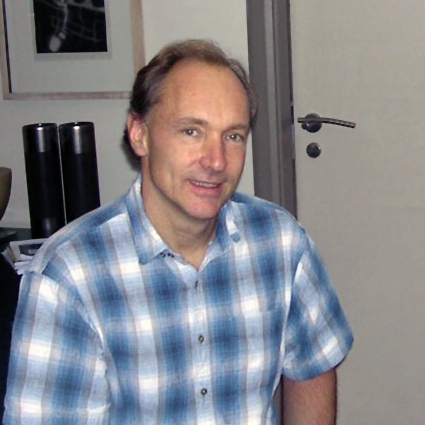


  This photo of Tim Berners-Lee is courtesy of Wikipedia: http://en.wikipedia.org/wiki/File:Tim_Berners-Lee.jpg

   Tim Berners-Lee is a computer scientist.  He was a contractor for CERN (the European Organization for Nuclear Research, http://www.cern.ch.) CERN needed a convenient way for physicists to communicate ideas, worldwide.

  After he wrote a proposal for a large hypertext database with typed links in 1989, he had developed the final designs for the World Wide Web by Christmas 1990.  (Hypertext is the concept of a bit of text being linked to another document.  Have you ever clicked on a link?  Congratulations!  You've used hypertext.)

  All of the necessary parts were ready, the Hypertext Transfer Protocol (HTTP), the Hypertext Markup Language (HTML), the very first web browser, WorldWideWeb, the first web server with its software, and the very first webpages.  Tim's WorldWideWeb browser could only run on NeXt computers, so Nicola Pellow, a woman at CERN, developed a web browser named WWW that could run on computers with Unix and MS-DOS operating systems.


  What is a NeXt computer?  NeXt computers were created by a company Steve Jobs started in 1985.  They were very expensive, not easily affordable for most consumers.  When Apple bought NeXt in 1997, Steve Jobs rejoined Apple, and the brand was discontinued.


  On August 6th, 1991, Tim announced the World Wide Web's public availability on the alt.hypertext newsgroup.
 
  By December 1992, the first Mac OS web browser, MacWWW, was released.  It was developed by Nicola Pellow and Robert Cailliau.

  In the very early days of the web, maybe up until 1995, web surfers were primarily academics and scientists.

   My family were early adopters of home Internet access technology, and I was a web surfer from the time I was ten years old in 1994.  My very first web browser was Mosaic.

   Part two starts in 1994.  In that upcoming post, I'll describe my very first days on the Web, and how Netscape's Navigator web browser quickly grew in popularity.  I'll also describe the beginning of yahoo.com, lycos.com, and the downfall of Prodigy Online, Compuserve and America Online (AOL).


Thursday, September 30, 2010

The Web and Your Brain!


 As a web designer, I've got to make sure that the web pages that I build are intuitive for the user.  That means that site navigation should be easily visible and accessible, the organization of my site (the sequence that my pages are linked together in) should be logical, and that there is NO page of my site that takes more than two clicks from my index page to get to.  

 Well, a lot of why that's important is due to how our brains work.  And, apparently, the Web, and the Internet overall, is reorganizing our brains!  Information is quicker than ever to access.  What's the weather forecast for Grimsby, Ontario?  How about Toronto, I'm going there tomorrow... Do FUNImation, Sentai Filmworks, or Bandai have any new anime licenses?  Did Stephen Harper say anything infuriating today?  Do I have any new Twitter followers? (Actually, I have many new followers everyday, check it out at twitter.com/kim_crawley!)  All of these questions can be reached with a few clicks.  Google, Wikipedia, RSS feeds (subscribe to mine at feeds.feedburner.com/kimcrawleycom-BrightIdeas) and social media are helping us access new information with great speed.  Therefore, people are developing shorter attention spans.  Television was nothing, you ain't seen nothin' yet!

 I've been using PCs daily since about 1992 (when I was eight years old!), and I've been on the Internet since 1994.  

 Last week, I was helping a family member post ads on kijiji.ca.  He does his everyday work on his computer.  He checks his e-mail and surfs the web regularly.  It surprised me that he needed my help.  But I can post a Kijiji ad in about thirty seconds, complete with photos and perfect spelling.  He can figure out how to do it himself, but it would take him such a loooong time.  And I've got to hold his hand while he uses Twitter.  "What do I do, Kim?"  "Type your message in 140 characters or less, then click 'tweet'!"  He can use the Internet for his purposes and enjoyment, but he seems slow and lacking confidence when he encounters something new.  I see something new, and within minutes, I'm using it as if I've always used it.

 He is a very bright man, but I grew up with computers and he didn't.  Of course, the brain is a lot more plastic when one is younger.

 But, according to a UCLA study (gosh, I hate linking to Fox News), there is hope for rewiring your brain with Internet use, even if you're older or new to the technology:

"We found that for older people with minimal experience, performing Internet searches for even a relatively short period of time can change brain activity patterns and enhance function," Dr. Gary Small, study author and professor of psychiatry at the Semel Institute for Neuroscience and Human Behavior at UCLA, said in a statement.
 he UCLA team worked with 24 neurologically normal volunteers between the ages of 55 and 78. Prior to the study, half the participants used the Internet daily, while the other half had very little experience. Age, educational level and gender were similar between the two groups.
 The participants performed Web searches while undergoing functional magnetic resonance imaging (fMRI) scans, which recorded the subtle brain-circuitry changes experienced during this activity. This type of scan tracks brain activity by measuring the level of blood flow in the brain during cognitive tasks. While the study involves a small number of people and more research on this topic is needed, small study sizes are typical of fMRI-based research.


 After the initial brain scan, subjects went home and conducted Internet searches for one hour a day for a total of seven days over a two-week period. These practice searches involved using the web to answer questions about various topics by exploring different websites and reading information. Participants then received a second brain scan using the same Internet simulation task, but with different topics.


 The first scan of participants with little Internet experience showed brain activity in the regions controlling language, reading, memory and visual abilities. The second brain scan of these participants, conducted after the home practice searches, demonstrated activation of these same regions, but there was also activity in the middle frontal gyrus and inferior frontal gyrus – areas of the brain known to be important in working memory and decision-making.


 Thus, after Internet training at home, participants with minimal online experience displayed brain activation patterns very similar to those seen in the group of savvy Internet users.


 Why don't I see that happening in real life?  Either they need to use greater numbers of test subjects, or I'm being too hard on my dear old family member.


 But now there's scientific data to suggest that the Internet is getting into our BRAINS!  Not just via computers, but also through smartphones, tablets, and any other device that can use the Internet.


 We've got to design our websites with user's brains in mind, but perhaps user's brains are being designed with our websites in mind, too.  That's strange, exciting, and creepy! 


kimcrawley.com


twitter.com/kim_crawley